The sound comes from the nostrils, not the throat. Short and clear, the same volume from first cycle to last.
← Back to all lectures
Technique · breakdown
Kapalabhati
It isn't a spiritual experience. It's physiology.
"Kapalabhati" means "shining skull." An active cleansing breath: sharp exhales from the belly, with a passive inhale.
Health
Path
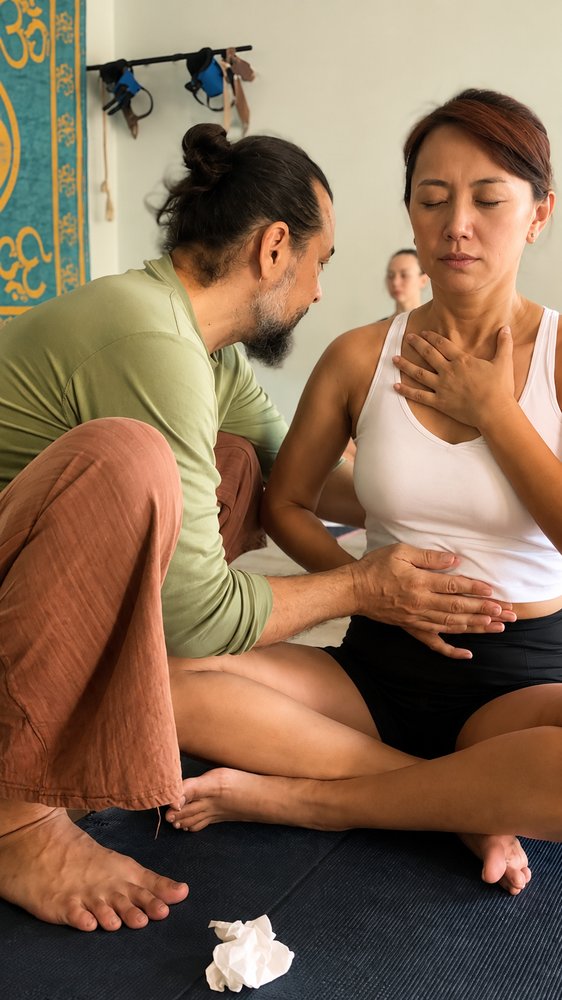
Demonstration
What it looks like in practice
What to watch for
The belly draws in on the exhale and is released on the inhale. The chest and shoulders stay still.
Only the exhale is active. The inhale happens on its own — nothing is done to produce it.
Filmed at our shala.
Essence
What it is
Kapalabhati is an active cleansing technique, one of the six shatkarmas. A strong exhale is created by a sharp contraction of the belly; the inhale happens on its own, passively.
To feel the mechanics straight away, recall how you sneeze.
Kapalabhati is that same natural cleansing reflex, only directed and repeated consciously.
The sound is born on the exhale and comes out of the nostrils.
Place in the system
Where it comes from
The Hatha Yoga Pradipika lists six cleansing actions before pranayama.
Kapalabhati is the second of the six.
Hence the timing: early in the morning.
How to perform
Step by step
- Sit upright, on an empty stomach. Take a calm breath in.
- Sharply draw the belly in — this produces a short, active exhale through the nose.
- Release the belly — the inhale happens on its own, effortlessly.
- Repeat in an even rhythm. Traditionally, about 108–120 exhales per minute.
- Traditionally three rounds of three minutes each.
- After each round, one minute of complete stillness.
Begin at one exhale per second.
Physiology
What happens inside
Rapid forced breathing lowers carbon dioxide levels. The blood shifts toward alkaline, and hemoglobin holds oxygen more tightly — so, paradoxically, the brain gets less.
That's why the "lightness and stars" from overdoing it aren't a spiritual experience, but mild oxygen starvation of the brain. Only extreme or incorrect technique leads to such states.
If the breathing volume is not changed, hyperventilation is guaranteed.
Carbon dioxide is not simply a waste product of breathing.
The bond between haemoglobin and oxygen becomes too stable.
This is what happens in ecstatic intense breathing.

Passive inhale
The belly releases, the diaphragm descends, air comes in on its own.
Active exhale
The belly snaps in, the diaphragm rises, air is pushed out.
The abdominal wall draws in, the air leaves through the nostrils.
The main rule
Controlling the volume
At high speed, a very small volume is exhaled.
Experience does not confirm hypoventilation at this volume.

100–150 ml
per exhale, from about 5 litres of total lung capacity
The highlighted zone
Dead space. No gas exchange here.
The zone below
The alveoli, where gas exchange happens.
The blue highlight marks the zone the air comes from.
Error marker
If dizziness appears, reduce the exhaled volume at once.
Condition of entry
On an empty stomach only
At least three to four hours after eating.
The reason is physiological.
Effects
What it's good for
With systematic practice, Kapalabhati works as a tool for cleansing and tone:
- clears the nasal passages and respiratory system (one of the six shatkarmas);
- activates the sympathetic system — alertness, circulation, metabolism;
- supports cognitive functions: memory, learning, speech, attention;
- Cognitive function: speech, memory, attention, thinking.
Therapeutic application
The effect on the respiratory system makes kapalabhati a therapeutic tool:
Chronic bronchitis. Bronchial asthma. Chronic sinusitis.
Required reading
Contraindications
A contraindication is a condition under which consequences follow by rule.
Always analysed, whatever the technique
- General 1
- General 2
- General 3
- General 4
Contraindications for kapalabhati and bhastrika
- Item 1
- Item 2
- Item 3
- Item 4
- Item 5
- Item 6
- Item 7
- Item 8
- Item 9
- Item 10
- Item 11
- Item 12
- Item 13
- Item 14
- Item 15
- Item 16
- Item 17
Safety always outweighs effect.
The breakdown
Two lectures on kapalabhati
One technique, two different ways into it.
The breath that awakens and cleanses
For those who came for their health.
$39
Coming soonThe first key. Entering the path of pranayama
For those who practise and are moving further.
$39
Coming soon
Practice focus
What this technique develops
Clear, active exhalation without forcing the throat or face.
Fast return to calm breathing after stimulation.
Respect for dosage: alertness without dizziness or strain.
Ready to walk the path in order?
Structured courses arrange these lectures into a sequence — with protocols and practice.
Go to the library