Take nothing on faith
Every claim in the materials can be checked — through physiology, a source, or your own practice.
To the lectures →A teacher is responsible not for the impression they make, but for the conditions under which a student can observe, understand, and make independent decisions.
Every claim in the materials can be checked — through physiology, a source, or your own practice.
To the lectures →A method only matters if it can be repeated and yields the same result.
To the techniques →The body and breath give feedback that charisma can't fake.
Principles →If an explanation works, it works regardless of who formulated it.
Common pitfalls →We do not simplify the subject. We simplify the explanation.
Technical terminology is useful when it improves precision. It is not useful when it only displays expertise. A teacher should be able to explain a difficult mechanism in language a student can understand, locate in their own body and use in practice.
The professional task is not to recite terminology or reproduce a sequence. It is to observe the person, understand the relevant factors, adapt the practice, recognise the limits of competence and accept responsibility for the teaching decision.
Support, traction, props, partner structure and guided movement are used to change the conditions of a task. The goal is not simply a deeper shape; it is a clearer, safer teaching decision.

A short safety lesson: hands-on work must preserve breathing mechanics.

A short warning about inappropriate neck loading during hands-on work.
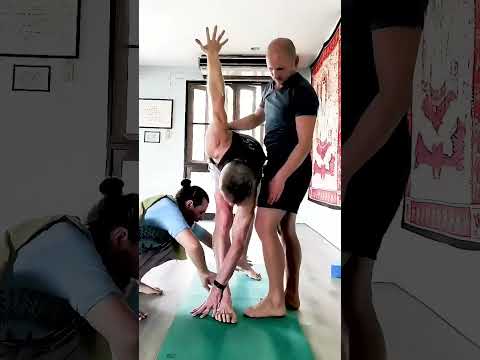
The teacher physically guides the assisting trainee’s movement pattern during supervised adjustment training.

Detailed hands-on teaching with positioning, breath, count and joint direction.

Students practise adjustments in pairs while the teacher supervises and corrects.

The wall is used as an external reference for alignment and controlled movement.

A prop changes the direction of support so the student can experience the movement more clearly.

Wall-based standing asana adjustments with attention to planes, axis and direction.

Two-teacher support changes the conditions of Urdhva Dhanurasana through stabilisation and directed traction rather than simply pushing deeper.

Stable external support in Baddha Konasana helps guide the forward movement without simply adding force.
These clips make the decision layer explicit: individual anatomy, load tolerance, pain signals and the difference between demanding practice and repeatedly reproducing an injuring movement.

Interview excerpt: safe adjustment requires anatomy, individual factors, load tolerance and understanding the direction of force.

Interview excerpt: injury risk rises when practitioners ask the body for more than it can currently provide.

Interview excerpt: distinguish discomfort from pain, monitor location and intensity, and do not reproduce pain in an already injured movement.

Elbow hyperextension used as a quick observation cue for joint hypermobility and connective-tissue-aware loading.
Gather data without premature interpretation.
Connect the observation to a testable mechanism.
Change the practice and test the result again.
A 45-lesson online course follows a complete practice to show how observation, biomechanics, modification, safety and hands-on assistance become real teaching decisions.
Study Art of Adjustment →