Observe
See the person in front of you: current state, limiting factor, readiness, pain signals and what is actually happening in the movement.
Learn to see the student before you touch the pose. A complete teaching-methodology course built through the logic of an Ashtanga practice: observation, biomechanics, hands-on assistance, modifications, safety and the decision of when not to adjust.
Adjustment is not forcing a pose. It is changing the conditions so the student can understand the movement.
This course is professional education, not automatic teacher certification. No certificate is promised simply for watching lessons.
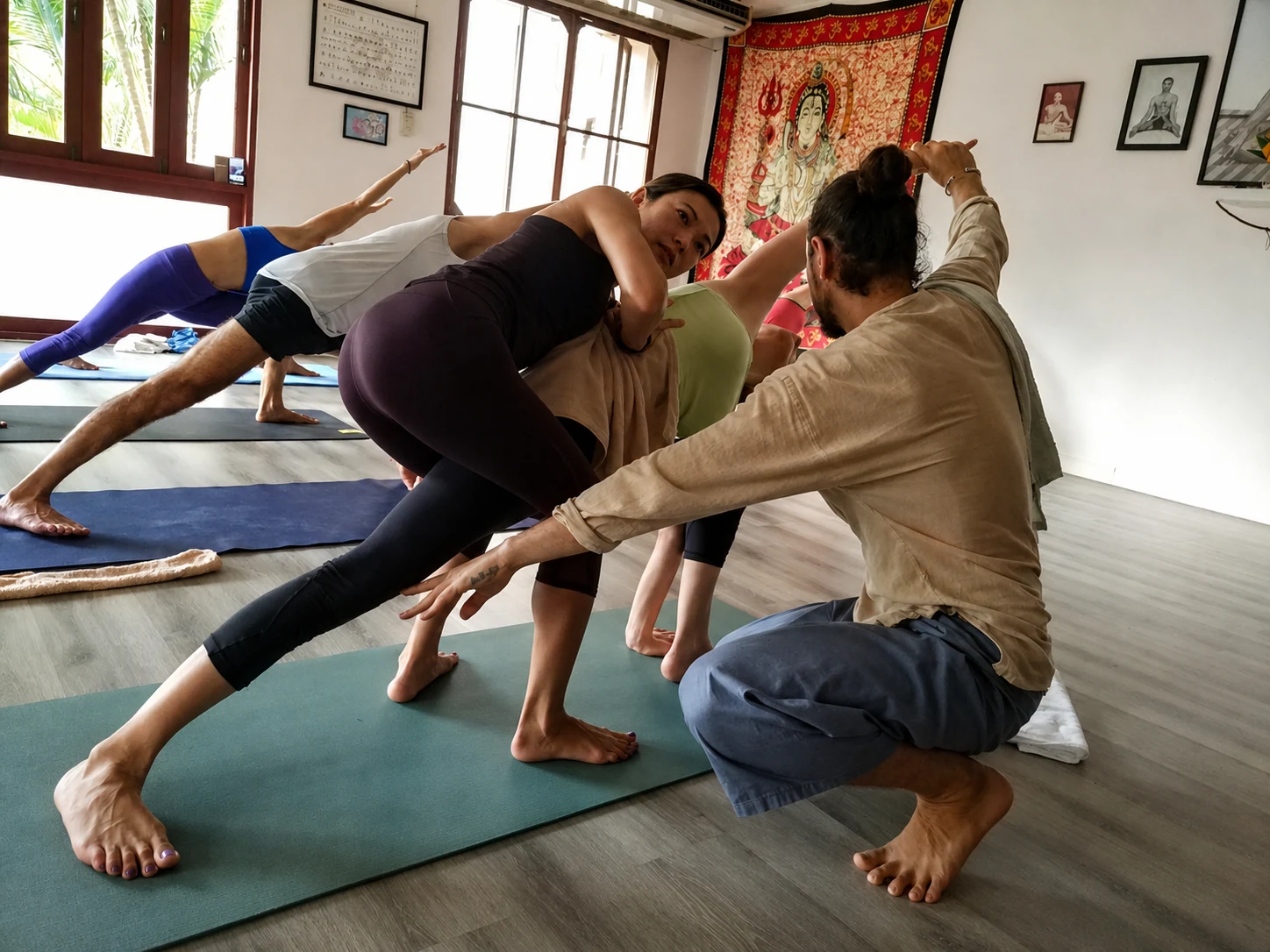
We do not treat online education as the transfer of more techniques. We create conditions in which professional capacity can develop: the ability to observe, understand, adapt and decide.
See the person in front of you: current state, limiting factor, readiness, pain signals and what is actually happening in the movement.
Relate what you see to biomechanics, load, intention, contraindications and the purpose of the task rather than only its external shape.
Change range, support, leverage, contact, direction or the task itself while preserving the educational purpose of the practice.
Know when to adjust, when to reduce load, when to change the task, when to stop and when the best intervention is no intervention.
Adjustment is not a collection of techniques. It is the ability to see, understand and make an appropriate decision for the person in front of you.
Designed for people who already take practice and teaching seriously. It is not a catalogue of impressive grips.
These are source screenshots connected directly to adjustment training and teacher development. Open any card to read the original review.
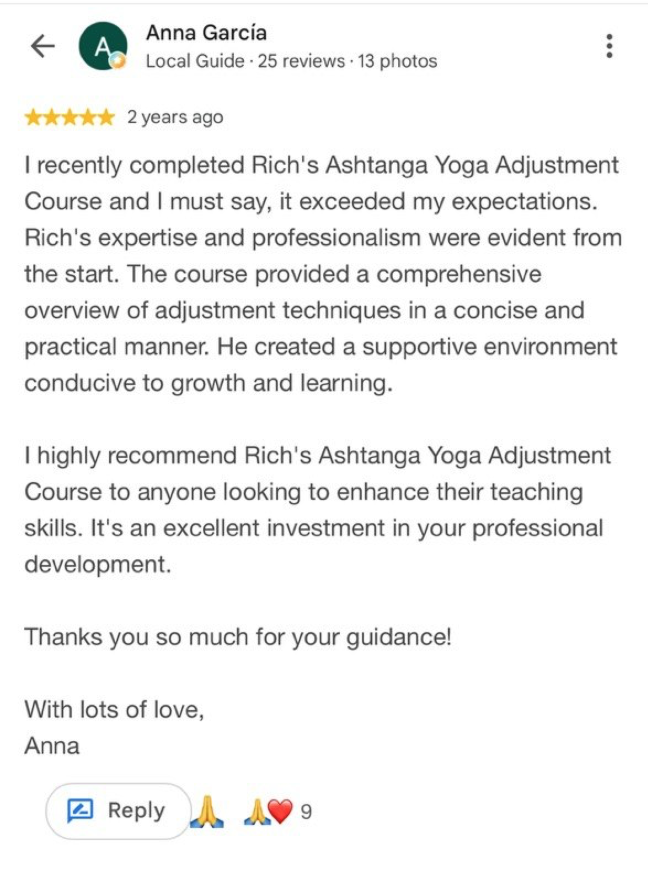
“The course provided a comprehensive overview of adjustment techniques in a concise and practical manner.”
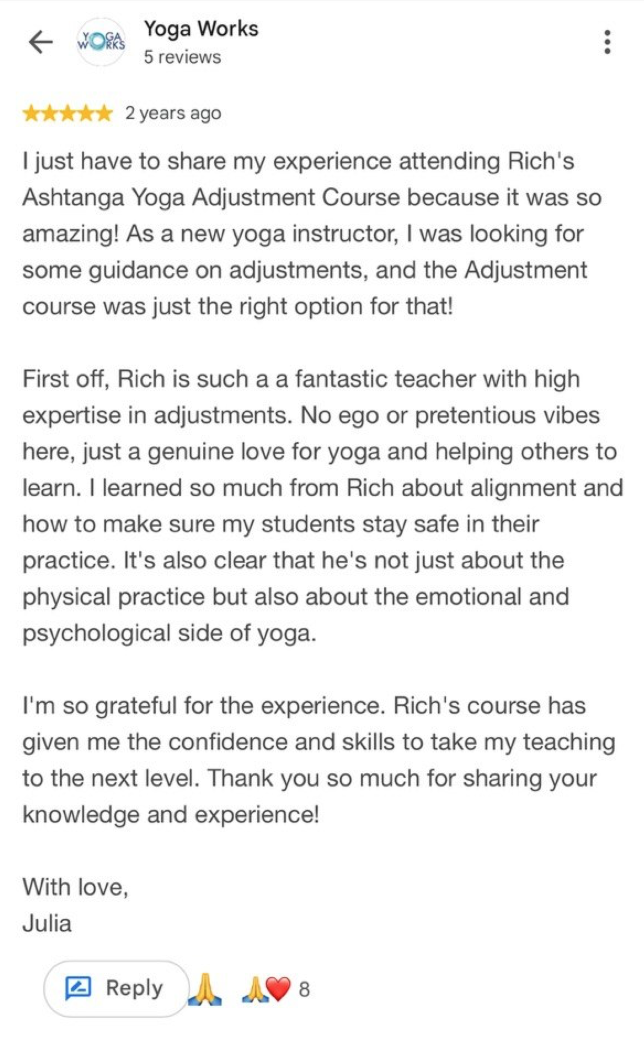
“Rich’s course has given me the confidence and skills to take my teaching to the next level.”
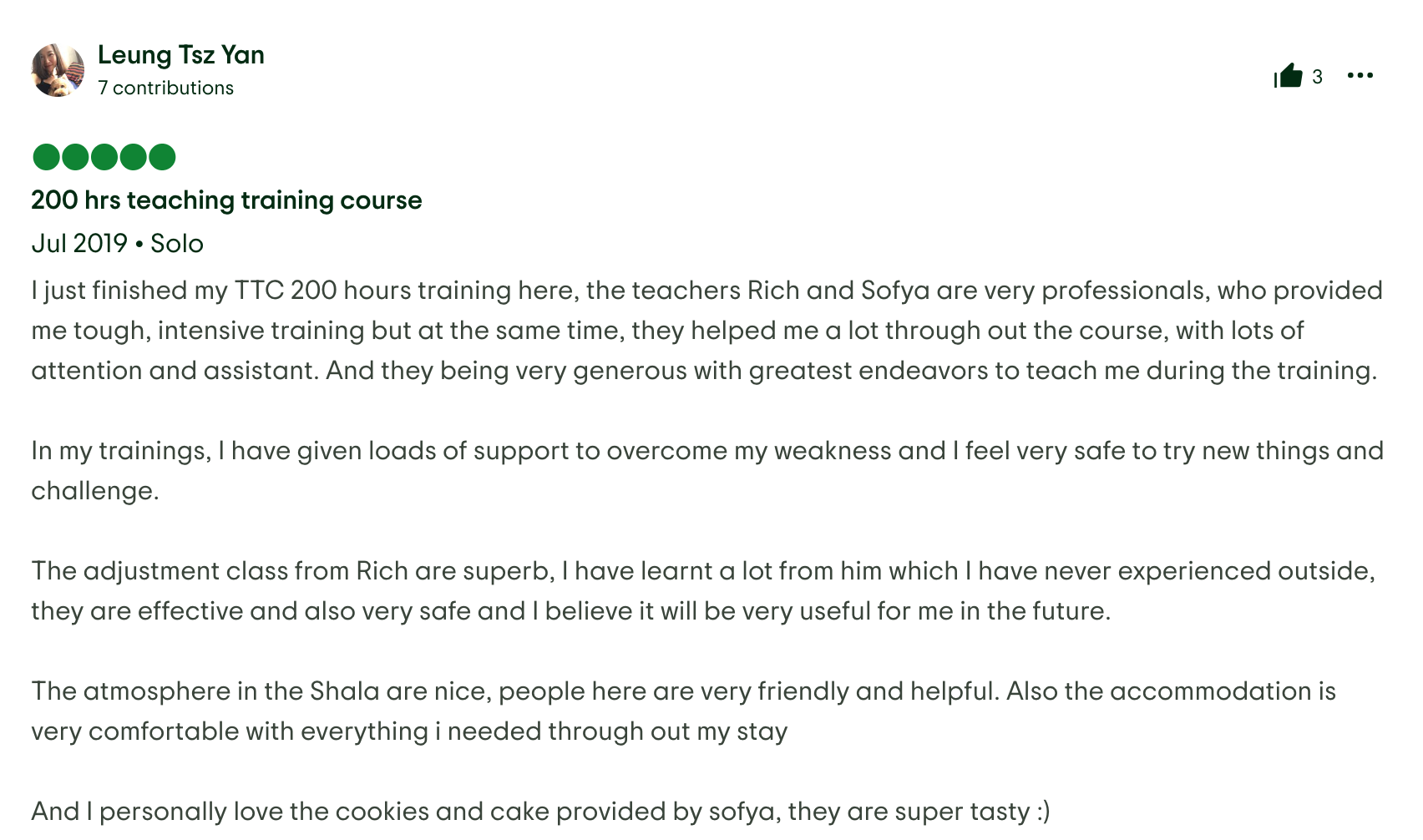
“The adjustment class from Rich are superb… effective and also very safe.”
The course follows the real sequence rather than grouping random techniques. That matters: the student’s state changes through the practice, and the teacher’s intervention should change with it.
Ujjayi, bandha, drishti, attention, pain, safety and the vocabulary used throughout the adjustment course.
Foundation, diagnostic observation, first modification and adjustment principles.
Direction, balance, hip mechanics, twists, forward folds, resistance and teacher positioning.
Vinyasa, folds, lotus-related work, arm balances, deep mobility, transitions and the beginner/experienced branch.
Backbending, inversions, neck safety, progressively lighter intervention and the return toward stillness.
“The sequence is not the student. The student comes first.”
Beginners complete the main work through Navasana and enter the finishing phase through accessible backbending options. Experienced practitioners continue through the later Primary Series to Setu Bandhasana before entering the same finishing phase. The sequence is not the student. The student comes first.
Art of Adjustment provides 8 hours of structured professional education in yoga adjustment and teaching methodology. Yoga Alliance Registered Yoga Teachers can use the completed training toward their Continuing Education record.
After completion, your Dashboard includes the certificate and a short reminder for adding the 8 hours to your Continuing Education profile.
US$99 gives you enrollment in the Art of Adjustment program. Payment is processed by Stripe. Your purchase is bound to your Prana Integrity account. After Stripe confirms payment, Art of Adjustment appears in My Training.
Sign in or create an account before payment. The course entitlement is verified server-side whenever you open the Academy.
No. The course can show beginner modifications, but its subject is teaching methodology and adjustment. It is primarily for teachers, trainees and serious practitioners.
No. One of the central ideas of the course is that teaching decisions depend on readiness. The curriculum explicitly includes modifications, branching and cases where an adjustment should not be used.
The practice sequence provides the laboratory, but the transferable subject is broader: observation, biomechanics, load, direction, support, safety and decision-making.
The course includes a final online assessment. A score of 50/100 or higher completes the assessment and makes the PDF completion certificate available automatically in the student Dashboard.
US$99 as a one-time payment.
For teachers maintaining active Yoga Alliance registration, the school can provide Continuing Education documentation for the training hours actually completed.
Course material and the standard completion process are available for six months. Additional mentoring can be arranged separately after that period.