Observe
See the person, the current state, the limiting factor and the difference between appearance and function.
Study recorded material at your own pace, then meet teachers live to practise, ask questions and demonstrate what you actually understand. Online does not mean unattended.
A teacher does not become capable by accumulating videos and facts. Professional capacity develops through study, practice, feedback, adaptation and decisions made in real situations.
See the person, the current state, the limiting factor and the difference between appearance and function.
Connect practice with applied anatomy, load, contraindications, intention and the purpose of the technique.
Modify the task, range, support, sequence or teaching approach according to the person rather than mechanically following a template.
Know when to progress, reduce load, modify, stop, refer onward or leave a student to work independently.
That is why contraindications, modifications, applied anatomy, live teacher contact and assessment are not extras. They are part of the educational method — creating a safer space in which capacity can develop without chasing form at any cost.
Pre-recorded lessons let you pause, repeat and return to difficult material instead of trying to absorb everything during a fixed timetable.
Between study blocks you practise independently. Then we meet live to check progress, clarify questions and test whether the material can be applied in practice.
A live meeting may be an asana class, pranayama practice, anatomy review, philosophy assessment, discussion of adjustments or a practical teaching check. The exact meeting depends on what you are studying at that stage.
The online format gives you flexibility without removing teacher oversight.
Work through recorded lectures, demonstrations, reading and assigned material at your own pace.
Repeat the material in your own asana, pranayama and teaching practice rather than treating video as passive content.
Schedule live teacher contact when a block needs correction, discussion, a class or direct observation.
Show what you understand through homework, conversation, practice and teaching assessment before moving on.
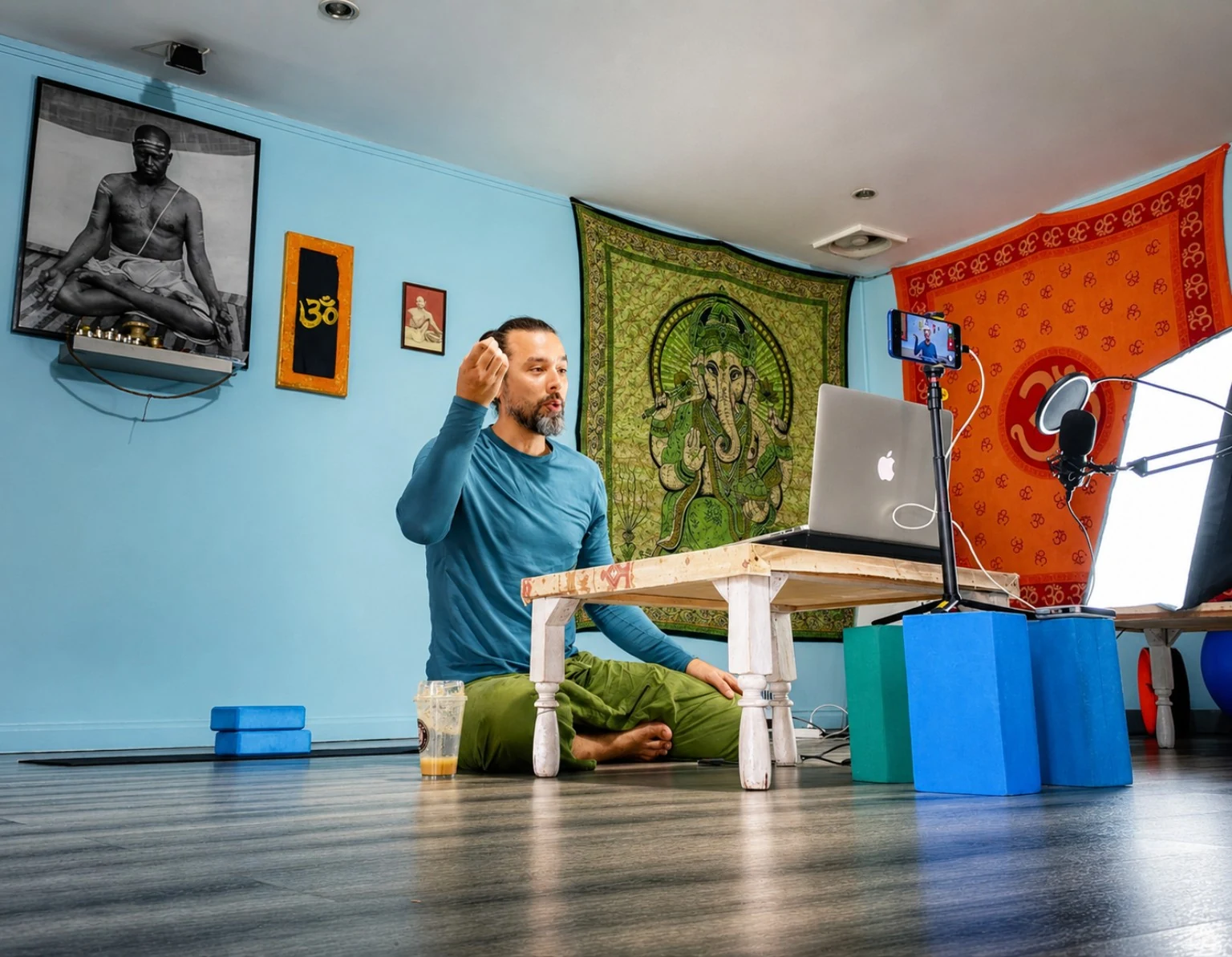
Frames from actual online education: live explanation, teacher-led review and anatomy material used during the learning process.
Direct explanation, questions and review with a teacher.
Material is explained, drawn, discussed and checked rather than only assigned.
Recorded and live materials support later discussion and assessment.
Personal practice, alignment, modification, sequencing, correction, demonstration and teaching application.
Breathing mechanics, progressive practice, technique, observation, limits and live work where direct feedback is useful.
Class design, explanation, demonstration, observation, adjustments and adapting a plan when the person in front of you changes.
Applied anatomy, movement, load, breathing mechanics and individual variation as tools for safer teaching decisions.
Recognising when to adapt, reduce, stop or refer rather than forcing a technique because it belongs to a sequence.
Study and discussion of yoga philosophy, history, ethics and related theory, followed by teacher-led checks of understanding.
Practice and theoretical study within the broader teacher-education curriculum.
Prepare classes, explain material, teach, receive feedback and repeat. A certificate is not used as a substitute for practice.
Most content is pre-recorded because that is often the most useful way to learn theory and demonstrations online. It gives you control over repetition and pace.
But teacher contact remains part of the program. Live sessions are used where observation, correction, questioning or assessment adds something a recording cannot provide.
We do not issue a teaching certificate simply because a student reached the end of a playlist.
Assessment can include assigned homework, discussion of theory and philosophy, anatomy review and practical teaching checks. In practical assessment we look at more than whether you can perform a posture: explanation, demonstration, counting, timing, observation and teaching decisions matter.
If a part of the material is not yet clear, it can be reviewed and tested again. The aim is not to make the assessment difficult for its own sake; it is to make the certificate mean that an educational process actually took place.
The program starts individually and can be spread over time. That makes it useful for people who cannot spend three continuous weeks in Phuket or who need to combine study with work and family responsibilities.
Online study also requires the ability to practise independently between meetings. Previous yoga experience can make that easier. If you are unsure whether the format fits your current level, send an application and we will answer before you commit.
One-time payment for the complete online teacher-education program: recorded study, guided teacher contact, learning materials and the completion / assessment process.
The school maintains Yoga Alliance registration. Graduates of the 200-hour program can request the documentation used for the Yoga Alliance registration pathway.
If you already maintain an active Yoga Alliance registration, Continuing Education documentation for eligible completed hours is available on request.
The standard guided completion and assessment window is 12 months from enrolment. Extended mentoring can be arranged separately when additional teacher contact is useful.
Payment is processed securely by Stripe.
No. Most study material is recorded, but scheduled live meetings with teachers are part of the process for practice, questions, correction and assessment.
Depending on your stage of study, a meeting may include an asana or pranayama class, anatomy review, philosophy assessment, discussion of adjustments, questions or practical teaching assessment.
Yes. The online program starts individually rather than waiting for a fixed group date.
The standard guided completion and assessment window is 12 months from enrolment. Extended mentoring can be arranged separately.
No. Completion of the required study and successful assessment are part of certification. Reaching the end of recorded material alone is not treated as teaching competence.
The programs share major educational areas, but the learning environment is different. Online study relies more heavily on recorded material and independent practice, with live contact used strategically for correction and assessment.
US$350 for the current online program.
Tell us about your current practice, what you want to learn and how much time you can realistically give to independent study. We will reply with practical details before you decide.