Complete beginner
Yes, you can join. You build the foundations of movement, breath, terminology and personal practice without being expected to arrive already trained.
Three weeks in Phuket. A foundation for years of practice, teaching and further study.
Small-group teacher education for complete beginners, experienced practitioners and yoga teachers. Learn to work with the body, breath and the person in front of you — not simply repeat a sequence.
Traditional Ashtanga Yoga Shala Phuket remains registered with Yoga Alliance.
No previous yoga experience is required. Previous practice is an advantage, not an admission requirement.
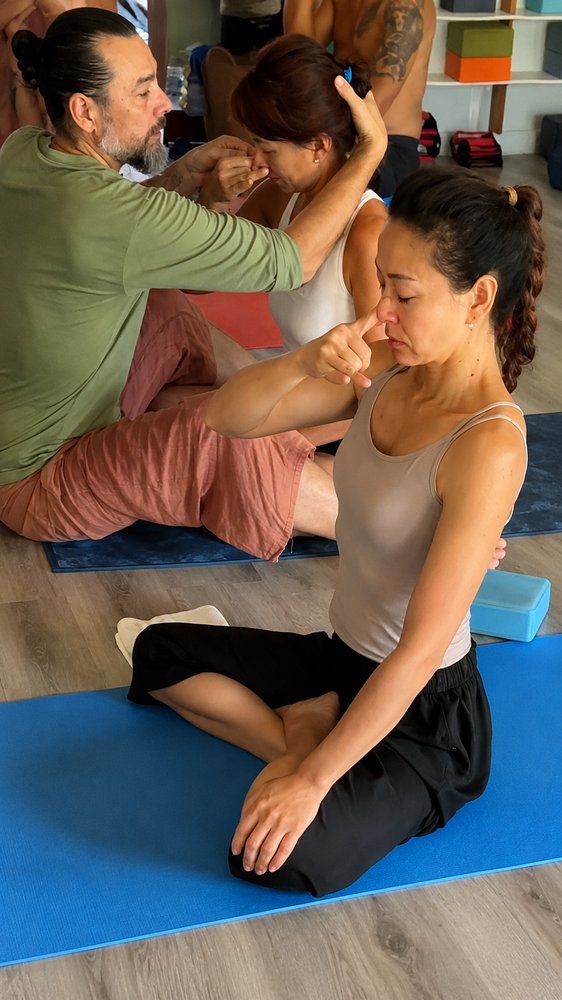
If Yoga Alliance registration matters to your professional plans, the answer should be easy to find. Successful graduates receive the school’s 200-hour certificate and can use it when applying for individual Yoga Alliance registration, subject to Yoga Alliance’s current requirements.
We do not believe a number of hours can make a mature teacher. A serious teacher keeps studying because every new student exposes another gap in what we know.
The purpose of these three weeks is to give you a practical foundation you can continue using for years: a personal practice, a way of observing, a framework for decisions, and the discipline to keep learning.
Three weeks can begin your education. They cannot finish it.
The course does not pretend that zero experience and ten years of practice are identical. It gives each participant a meaningful starting point.
Yes, you can join. You build the foundations of movement, breath, terminology and personal practice without being expected to arrive already trained.
Existing practice frees attention for deeper work with pranayama, anatomy, teaching methodology, adjustment and adaptation.
Work beyond memorising shapes: refine observation, teaching decisions, individualisation and the relationship between asana and breath.
Use the training as continuing education in safety, contraindications, modifications, pranayama and the practical craft of teaching different people.
A sequence can be memorised. Teaching requires seeing what is happening, understanding it, adapting the tool and accepting responsibility for the decision.
See the person in front of you rather than only the intended shape.
Know what a movement or breathing technique is intended to do and what changes the load.
Change range, rhythm, support, sequence or technique when the person requires it.
Know when to progress, when to reduce, when to change the technique or not give it at all. Making a decision also means accepting responsibility for its consequences.
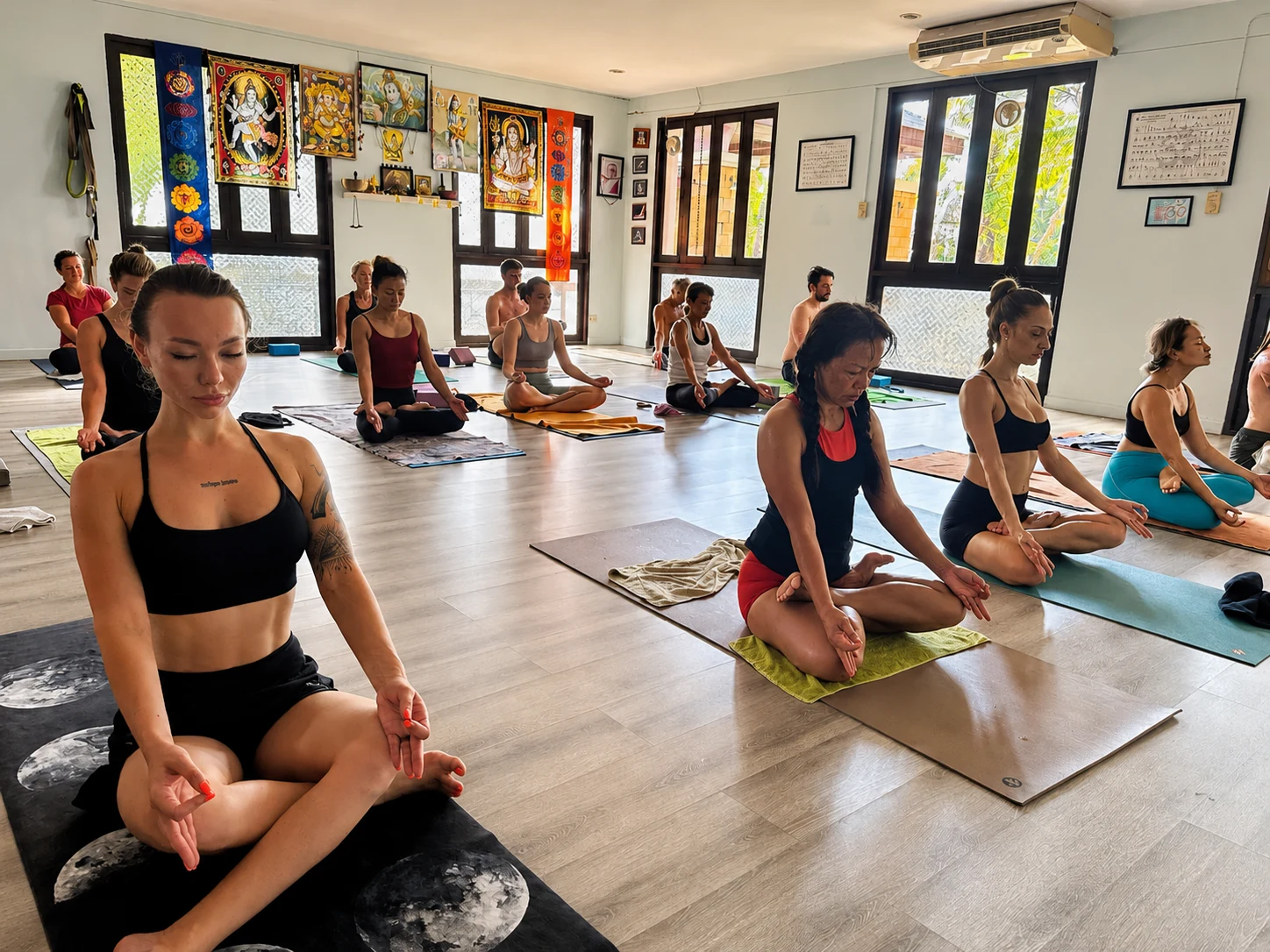
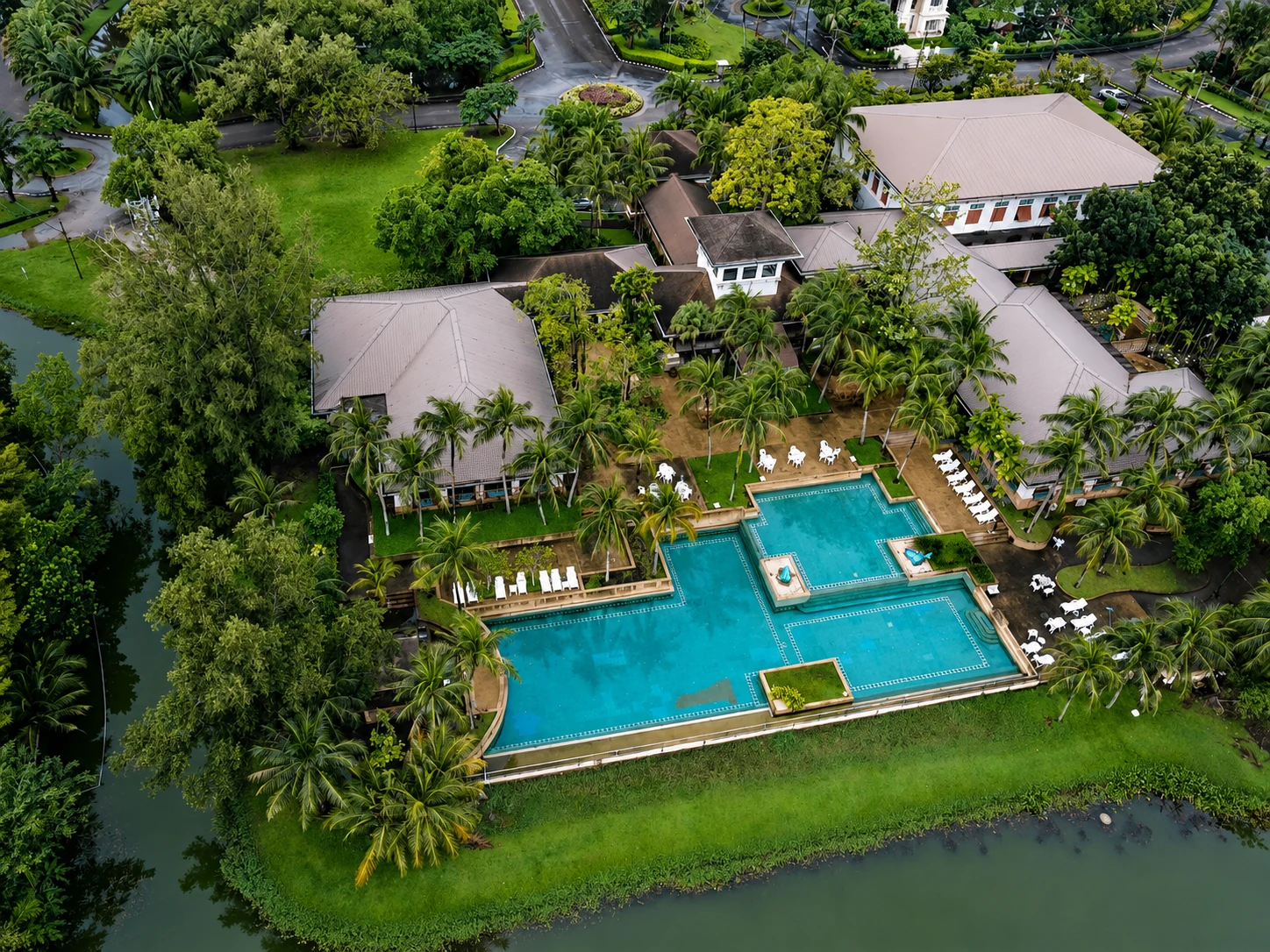
We concentrate the formal training into the first part of the day so that three weeks of education do not erase the fact that you travelled to an island. Afternoons remain available for rest, study, the beach and life outside the classroom.
These are real moments outside the formal timetable: shared time after training and a day off at Banana Beach. They show the human environment around three weeks of serious study without turning leisure into a promised course component.
The elements are taught in relationship to one another: movement changes breathing; breathing changes state; anatomy changes what is safe; teaching changes when the person changes.
Personal practice, alignment, modifications, sequencing, strength, balance, mobility and teaching application.
Progressive breathing practice, mechanics, rhythm, intensity, application, limits and integration with asana.
Explore the Pranayama foundation →Structure and function as tools for understanding movement, load and adaptation — without pretending to practise medicine.
Explore Applied Anatomy →Observation, explanation, demonstration, adjustment, class design, time management and teaching practice.
Mechanisms of risk, red flags, adaptation, limits of competence and the responsibility to stop when necessary.
Watch Contraindications · Part 1 →Attention, contemplative practice, historical context and the philosophical questions behind the techniques.
The anatomy block is not a decorative certificate. These clips show classroom reasoning about spinal structure and applied observation of joint hypermobility.

Lecture fragments connect cultural context with vertebral structure, the spinal canal, cervical anatomy and intervertebral-disc mechanics.

An interview fragment used to discuss hyperextension, ligament behaviour and why visible range should not automatically be treated as better function.
Hip capacity, unstable support and partner work show why specialised movement is part of the toolkit: the task changes so a specific limiting factor can be trained rather than forcing the person through one fixed sequence.
Specialised movement work for hip capacity within a broader training toolkit.

A soft block and hip-to-hip partner contact turn balance into a shared proprioceptive, coordination and attention task.

Partner support and the wall provide an external reference for alignment while reducing the balance demand.
These clips show different parts of the same educational process: disciplined practice, adaptive teaching, cueing, hands-on methodology, assessment and completion.

Synchronized led practice, counting, discipline and teacher supervision.

Two-teacher support changes the conditions of Urdhva Dhanurasana through stabilisation and directed traction rather than simply pushing deeper.

Teacher trainees practise movement, breath, counting and verbal cueing in several languages.
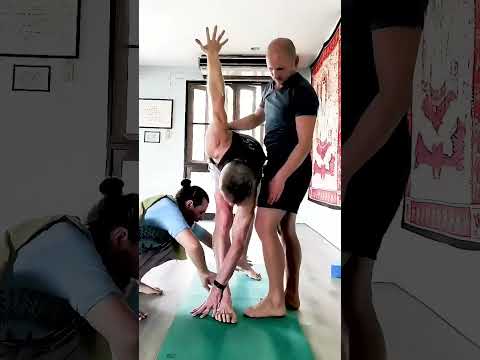
The teacher physically guides the assisting trainee’s movement pattern during supervised adjustment training.

A student moves from assisted Kukkutasana to independent repetition.

A dynamic view of the practical examination process. It complements the longer assessment-and-certification footage and shows disciplined integration under examination conditions.

Certificate handover and a warm completion moment after training.

A teacher trainee observes Mysore teaching, adjustments and room management rather than doing personal practice that day.
These short interview and training fragments connect observation, individual anatomy, pain signals and load management with the practical responsibility of teaching real people.
A teacher trainee observes Mysore teaching, adjustments and room management rather than doing personal practice that day.

Interview excerpt: safe adjustment requires anatomy, individual factors, load tolerance and understanding the direction of force.

Interview excerpt: distinguish discomfort from pain, monitor location and intensity, and do not reproduce pain in an already injured movement.

Elbow hyperextension used as a quick observation cue for joint hypermobility and connective-tissue-aware loading.
The Primary Series gives us a repeatable structure. Repetition makes it possible to observe breathing, movement, attention, adaptation and change instead of constantly replacing the material.
The training then expands the toolkit beyond one sequence.
A typical training day begins at 7:30 AM and usually finishes around 3:00–3:30 PM. Sunday is free.
The exact sequence of theory, workshops and practice can change with the group and the training plan. Independent practice, preparation and assignments continue outside formal class time.
The program combines scheduled teacher-led training with structured independent study, repetition, preparation and teaching practice outside the formal timetable.
The exact workload is built from the real course plan rather than from a promise that a number of hours can make anyone a finished teacher.
A lecture can be delivered to a large room. Teaching someone to teach requires watching how each participant moves, breathes, understands, explains, adjusts and changes. We therefore keep the group to approximately five or six students.
The training is taught by Rich (Alexey Toropov) and Sofya Linkova. Both teachers work with students throughout the course, each in the areas where they have the strongest education, training and practical experience.
Teacher and practitioner based in Phuket whose work connects asana, pranayama, anatomy, adaptation, contraindications and teaching decisions for the person in front of you.
Years of personal practice and teaching in Phuket, with Ashtanga as a long-term practical foundation and continuing work in pranayama, adjustment and individual adaptation.
Studied in the Yoga Therapy program at the Institute of Eastern Methods of Rehabilitation in Saint Petersburg and completed an attestation thesis in that program. Continues specialist education, including recent extended study of pranayama.
Pranayama, asana methodology, adjustment, adaptation, anatomy-informed teaching, contraindications, safety and the logic of teaching decisions.
Works with students throughout the course and leads the blocks that fall within these areas of deeper preparation and experience.
Teacher, long-term practitioner and qualified theologian. Her work combines disciplined personal practice with continuous study, analysis and integration of new material into the educational process.
A strong and consistent personal practitioner whose practical experience is an active part of how the course is taught rather than a separate biography line.
Formally educated in theology, with philosophy and related academic disciplines forming part of that education. Continues studying, testing, integrating and refining material rather than treating education as finished.
Personal practice, theory, philosophy and the areas of the curriculum in which her education and practical preparation are strongest.
Works with students throughout the course and takes primary responsibility for the parts of the program that fall within her areas of deeper preparation and experience.
The teaching team works in Phuket through Traditional Ashtanga Yoga Shala Phuket, established in 2014.
Confirms successful completion of the 200-hour Yoga Teacher Training — Pranayama & Asana.
Confirms completion of the anatomy component. It is not a medical qualification and does not authorise diagnosis or treatment.
A practical study reference drawn from the work behind “The Body Does Not Know the Yoga Sutras”, focused on contraindications, mechanisms of risk and adaptation in yoga practice.
Course reading on teaching, responsibility, ethics, boundaries, competence and the difference between demonstrating techniques and actually teaching people.
The training grows from more than a decade of daily practice, teacher education, pranayama, yoga therapy, workshops and work with students of very different levels in Phuket. Prana Integrity is the next form of that accumulated educational work.
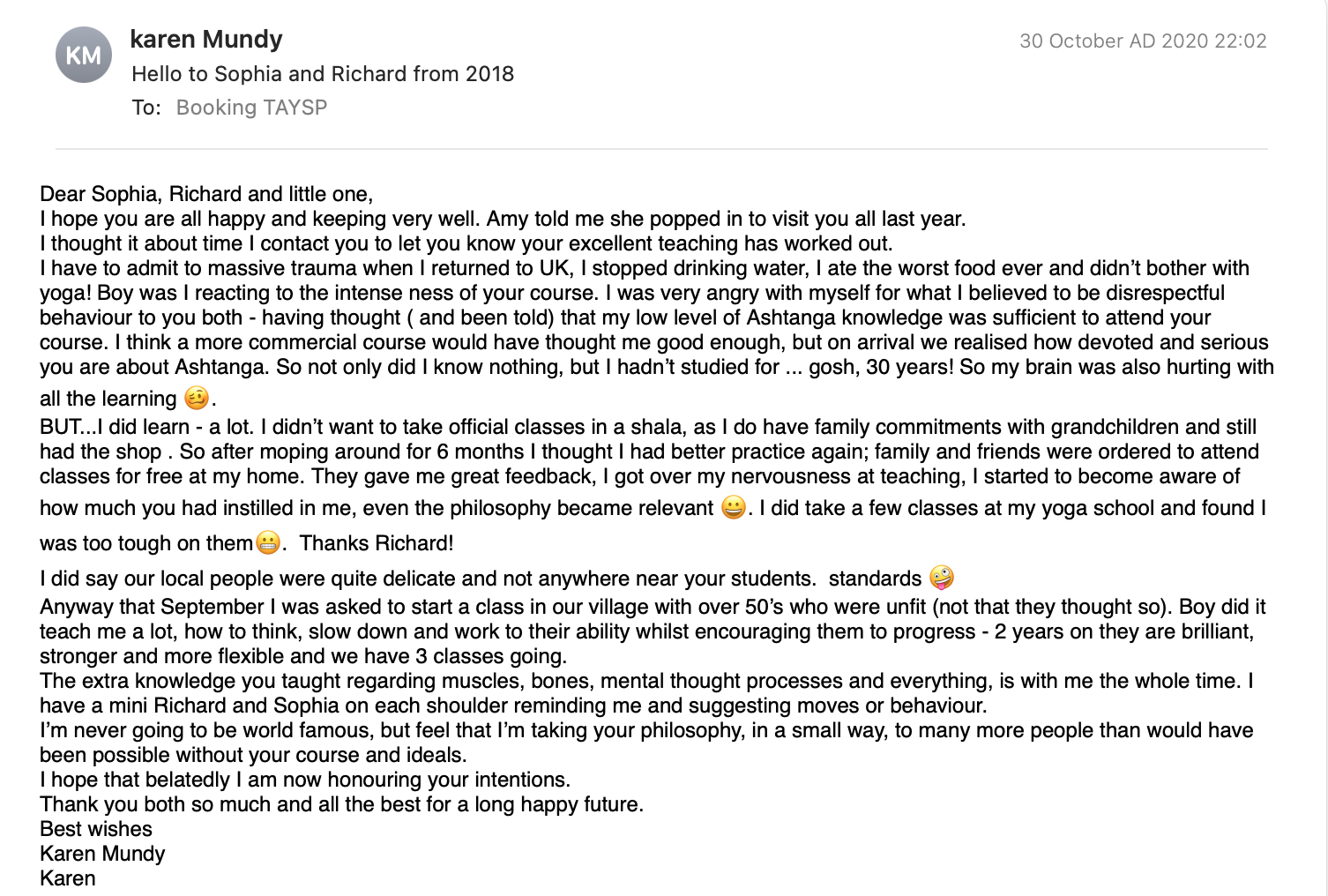
“Boy did it teach me a lot, how to think, slow down and work to their ability whilst encouraging them to progress.”
After her 2018 training, Karen later wrote that she had moved into teaching adults over 50 and was running three local classes. What she valued most was not a memorised sequence, but learning how to think, slow down and work to the person in front of her.
Read the full source letter →One student describes arriving with prior yoga experience, being surprised by the intensity of the first week, working through resistance and then engaging more deeply with the process.

A TTC student describes initial resistance to the intensity of training and deeper engagement after working through it.
The 200-Hour Pranayama & Asana Teacher Training now introduces selected principles for working with children: observation before intervention, adapting language and load, clear boundaries, parent example and progression toward independent practice. This is not a separate certification.

A real Sunday family class showing how children participate in a serious shared practice alongside adults.

A faster view of shared standing work, strength, seated practice and concentration.
This three-week education-only track follows the same learning environment and curriculum as the in-person TTC, but you do not enter the teaching-certification examination simply by joining the track.
The fee is for the educational process.
Accommodation and meals are not included. We generally prefer students to choose their own accommodation and organise food according to their budget, dietary preferences and the way they want to live during three weeks in Phuket.
Local guidance can be provided when needed. You are not required to buy a retreat package in order to study with us.
Choose a published training date. A 25% deposit reserves the place. If you prefer to pay the full tuition now, the current direct-payment price includes a 5% saving.
Accommodation and meals are separate. Payment is processed securely by Stripe.
Yes. No previous yoga experience is required. Previous practice is useful because it frees attention for deeper material, but it is not an admission requirement.
No. Ashtanga Primary Series is the practical foundation, but the curriculum extends into pranayama, additional movement sequences, workshops, anatomy, adaptation, teaching methodology, meditation and Yoga Nidra.
Three weeks can give you a serious foundation and a certificate of completion. Teaching maturity develops through continued practice, study, observation and experience. We do not promise otherwise.
Training runs Monday through Saturday. A typical day starts at 7:30 AM with practice and finishes around 3:00–3:30 PM after adjustment work, pranayama and the scheduled theory or workshop block. Sunday is free.
English is the shared language of the international group. Russian or limited Spanish clarification may sometimes be possible individually, but English remains the language of the course so that everyone can participate equally.
No. Tuition is US$1,600 for the educational process. Students usually arrange their own accommodation and food. Local guidance can be provided if needed.
It confirms attendance and completion of the anatomy block within the training. It is not a medical licence, does not qualify the holder to diagnose disease, and does not authorise treatment.
Yes. The 200-hour format includes scheduled teacher-led training together with structured independent study, personal practice, preparation, class design, teaching practice, reading and review. The number describes the format, not the limit of a teacher’s education.
Yes. Traditional Ashtanga Yoga Shala Phuket remains registered with Yoga Alliance.
Applying does not commit you to payment. Tell us about your current experience, what you want to learn and when you would like to come to Phuket. We will reply with the next available training dates and practical details.
Complete beginners are welcome.
PRANA Integrity holds the structured online curriculum and specialised professional modules. TAYSP remains the place for in-person Ashtanga practice, Mysore classes and Phuket-based training with the same teaching ecosystem.

